
Why 10 Minutes of Yoga Could Change Your Entire Day
A 10 minute beginner yoga workout is one of the fastest ways to stretch your body, clear your head, and build a fitness habit — all before your coffee gets cold.
Here’s what a basic 10-minute beginner yoga session looks like:
- Neck stretches – release tension in the upper body (30-60 sec)
- Cat-Cow – warm up the spine (3-5 rounds)
- Downward-Facing Dog – stretch the full back body (5-8 breaths)
- Low Lunge – open hips and build leg strength (each side)
- Warrior II – build balance and lower body strength (5-8 breaths)
- Child’s Pose – rest and reset (30-60 sec)
- Seated twist or Cobra – finish with a gentle spinal release
No gym. No equipment. Just a mat and 10 minutes.
It turns out a lot of people feel exactly this way. When one yoga instructor started posting videos online, nearly 90 percent of her audience requests were for 10-minute morning routines — not hour-long classes. People are busy. They want something real that fits into their actual life.
The good news? A short yoga session isn’t a compromise. Even 10 minutes in the morning can deliver a full-body stretch, improve your focus, and set a positive tone for the rest of the day.
Whether you’ve never done yoga before, you’re coming back after a long break, or you just can’t carve out an hour — this guide is for you.
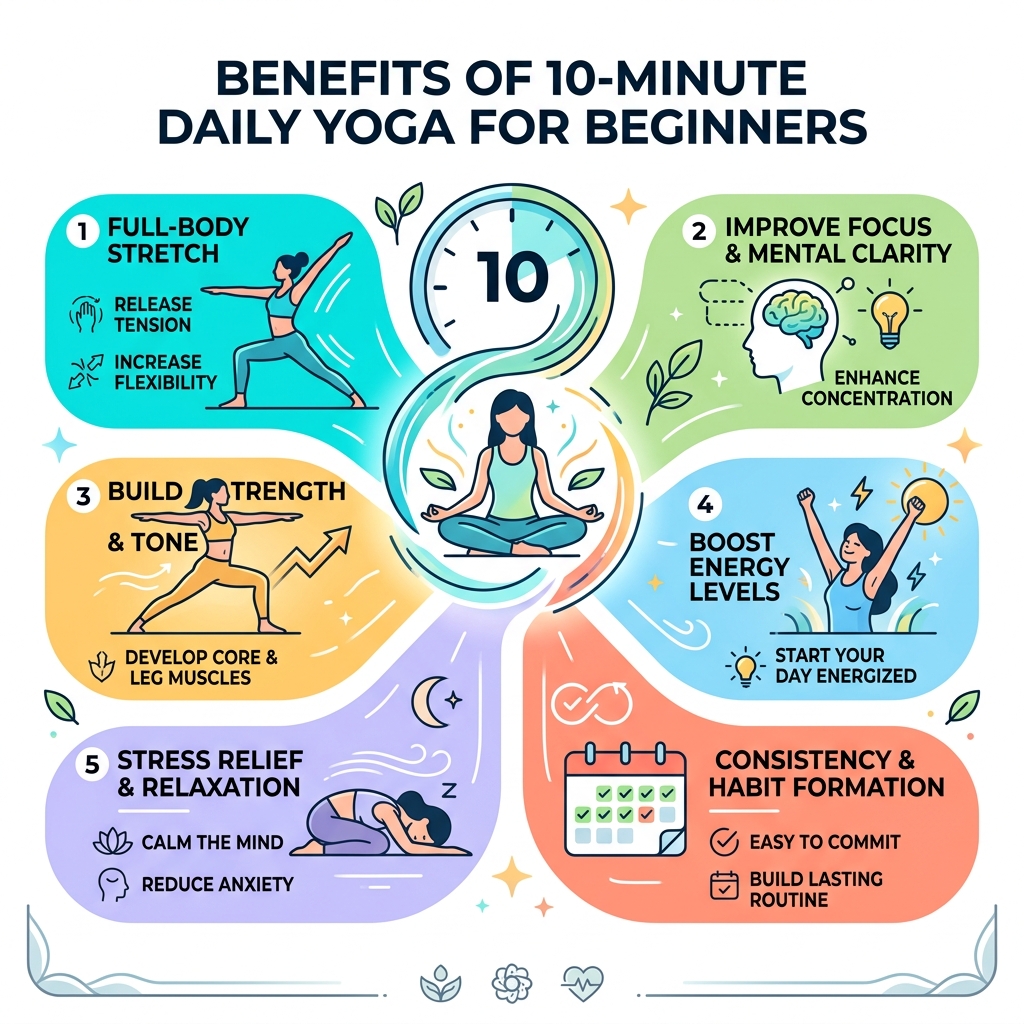
Why a 10 Minute Beginner Yoga Workout is Your Secret Weapon
We often think that if we can’t spend an hour at the gym, the workout doesn’t count. But when it comes to yoga, consistency beats intensity every single time. A 10 minute beginner yoga workout is your secret weapon because it removes the biggest barrier to entry: time.
The Power of the Full-Body Stretch
In just ten minutes, you can move your spine in all the ways it was designed to move—flexion, extension, and twisting. This helps relieve the “morning “stiffness” or the “desk-slump” aches we all know too well. By incorporating a 10-Minute Morning Yoga for a Full-Body Workout, you aren’t just stretching muscles; you’re lubricating joints and improving circulation.
Mindfulness and Intention Setting
Yoga is more than just physical movement. It is a mindfulness tool. Even a short practice serves as a mirror to your emotional state. We recommend asking yourself a few key questions during these ten minutes:
- How am I feeling right now?
- Where in my body could use a little more care?
- What kind of day do I want to have?
Setting a “word of the day” or an intention acts as an anchor. When things get stressful later in the afternoon, you can return to that word to regain your balance.
Habit Formation and Energy Boosts
Starting your day with a 10-minute daily workout routine for beginners builds a powerful psychological momentum. It’s a “win” you achieve before most people have even hit snooze for the third time.
The data backs this up. There is a massive demand for short-form yoga; in fact, 90 percent of requests for yoga practices are for 10-minute morning classes. Furthermore, the popularity of short-form beginner yoga is evident in the marketplace, with specialized beginner yoga DVDs ranking as #2 best-sellers in the exercise and fitness category on Amazon, often boasting 4.9-star user ratings. People love these routines because they actually do them.
Essential Poses for Your Daily Flow
If you are new to the mat, the terminology can be confusing. Do you need Hatha or Vinyasa? For a 10 minute beginner yoga workout, we usually look for a blend.
- Hatha Yoga: Generally slower-paced and focuses on holding poses to learn alignment. It is fantastic for beginners who want to feel stable.
- Vinyasa Yoga: Focuses on “flow,” where you move from one pose to the next on an inhale or exhale. This is great for building a bit of heat and improving cardiovascular health.
| Feature | Hatha Yoga | Vinyasa Yoga |
|---|---|---|
| Pace | Slower, meditative | Faster, rhythmic |
| Focus | Alignment and form | Breath-to-movement flow |
| Difficulty | Beginner-friendly | Moderate to high |
| Best for | Stress relief & foundation | Fitness & flexibility |

Core Poses in a 10 Minute Beginner Yoga Workout
To get the most out of your ten minutes, we suggest focusing on these foundational poses. You can find detailed variations of these in 10-Minute Morning Yoga for Beginners You Can Practice Anywhere.
- Cat-Cow: From a tabletop position (on hands and knees), inhale as you drop your belly and look up (Cow). Exhale as you round your spine like a Halloween cat (Cat). This is the gold standard for spinal mobility.
- Downward-Facing Dog: This inverted “V” shape stretches your hamstrings and strengthens your shoulders. If your hamstrings are tight, keep your knees bent!
- Mountain Pose (Tadasana): It looks like just standing, but it’s about active grounding. Engage your thighs, draw your belly in, and stand tall.
- Warrior II: A power pose. It builds leg strength and inner confidence. Gaze over your front hand and feel your strength.
- Plank and Cobra: These build core and back strength. When lowering from Plank to your belly, keep your elbows tucked in to protect your shoulders.
- Child’s Pose: Your “home base.” If anything feels too intense, sink your hips back to your heels and rest your forehead on the mat.
Sample Sequence for a 10 Minute Beginner Yoga Workout
Ready to try it? Follow this simple flow. Remember to keep a beginner-mindset-for-exercise—it’s not about being perfect; it’s about showing up.
- Minutes 0-2: Grounding and Neck Stretches. Sit comfortably. Drop your left ear to your left shoulder for five breaths, then switch. Set your intention.
- Minutes 2-4: Spinal Warm-up. Move into 5 rounds of Cat-Cow. Transition into a gentle Thread the Needle to stretch the shoulders.
- Minutes 4-7: Strength and Balance. Move into Downward-Facing Dog. Step forward into a Low Lunge. Rise up into Warrior II. Hold each side for 5-8 deep breaths.
- Minutes 7-9: Strengthening. Flow through a Plank into a Baby Cobra (lifting the chest slightly). Push back into Child’s Pose.
- Minute 9-10: Closing. Return to a seated position. Close your eyes. Revisit your intention and notice how your body feels different than it did ten minutes ago.
Maximizing Safety and Overcoming Physical Limitations
We want you to feel empowered, not injured. One of the biggest myths is that you have to be flexible to do yoga. In reality, being inflexible is exactly why you should do yoga!
Safety and Form for Your 10 Minute Beginner Yoga Workout
Proper form is essential for injury prevention. We always emphasize “subtle body connection.” This means listening to the small signals your body sends before they become loud pains.
- Nasal Breathing: Always breathe through your nose. It helps calm the nervous system and keeps your energy steady.
- Knee Modifications: If your knees hurt in a lunge or Cat-Cow, use a blanket for extra cushioning.
- Spinal Length: In forward folds, it is better to bend your knees and keep a long spine than to keep straight legs and a rounded, hunched back.
- Core Engagement: Imagine drawing your navel toward your spine. This “corset” effect protects your lower back during every pose.
For those just starting out at home, check out your-first-home-workout-a-beginners-guide for more tips on setting up a safe space.
Essential Props for Beginners
You don’t need much, but a few tools can make a world of difference.
- Yoga Mat: Provides grip and cushioning. See our guide on the best-yoga-mats-for-beginners.
- Blocks: These “bring the floor to you.” If you can’t reach the ground in a stretch, rest your hands on blocks.
- Blanket or Towel: Great for padding knees or sitting on to help tilt the pelvis forward.
Explore more options in our list of top-yoga-props-for-beginner-yogis.
Modifications for Inflexibility and Chronic Issues
Yoga is for every body. If you have specific physical limitations, you can still enjoy a 10 minute beginner yoga workout.
- Back Pain & Hip Stiffness: Focus on gentle twists and “Reclined Figure 4” stretches. Avoid deep forward bends if they cause sharp pain.
- Neuropathy and Ataxia: Balance can be a challenge. We recommend practicing near a wall or using a chair for support. Chair Yoga is a highly effective variation where you perform most poses while seated.
- Osteoporosis: Be careful with poses that require deep rounding of the spine. Focus on lengthening and “flat back” positions instead.
- Seniors: Many beginners over 70 find that 10 minutes is the perfect duration to build strength without overtaxing the joints.
If you prefer a more “non-spiritual” or fitness-focused approach, there are many routines designed specifically for men and “inflexible people” that focus purely on technique and muscle activation. Whether you are following a guide by an expert like Dean Pohlman or a gentle session with Yoga With Adriene, the goal is the same: move your body in a way that feels good.
Frequently Asked Questions about Beginner Yoga
How often should a beginner practice a 10-minute yoga routine to see results?
Consistency is the most important factor. We recommend practicing daily or at least every other day. Because the commitment is only ten minutes, it is much easier to stick to than a long gym session. Over time, these small sessions add up to significant changes in mobility and stress levels. You can learn more about building this habit in our guide on creating-a-home-fitness-schedule.
Can a 10-minute workout really improve flexibility and strength?
Yes! While you won’t become an Olympic gymnast in ten minutes, you will see improvements in your range of motion and muscle activation. By consistently engaging your core, glutes, and shoulders, you build functional strength that helps with daily activities like lifting groceries or sitting with better posture. It’s all about that “subtle body connection”—learning how to engage the right muscles at the right time.
What equipment is absolutely necessary for a 10-minute session?
Technically, all you need is yourself. You can even practice some morning stretches directly in bed! However, for a standing 10 minute beginner yoga workout, a non-slip yoga mat is highly recommended for safety. If you have tight hamstrings, a simple hand towel or a sturdy book can act as a substitute for a yoga strap or block.
Conclusion
At NextFin Capital, we believe that health is the ultimate investment. You don’t need a massive “capital injection” of time or money to start feeling better. By dedicating just ten minutes a day to a 10 minute beginner yoga workout, you are investing in your long-term fitness, mental clarity, and physical resilience.
The journey to a more flexible, stronger version of yourself doesn’t start with a marathon; it starts with a single breath and a few simple stretches. We invite you to roll out your mat, set your intention, and stretch your potential today.
Ready to take the next step in your fitness journey? Explore our full library of workout routines to find the perfect fit for your lifestyle.
