
Why So Many People Are Starting an Exercise Routine at Home Right Now
Starting an exercise routine at home is simpler than most people think. Here’s how to do it:
- Get medical clearance – Check with your doctor before beginning, especially if you’re new to exercise
- Set a SMART goal – For example: “I will do 10 push-ups in 8 weeks”
- Start small – Aim for 2-3 sessions per week, 20-30 minutes each
- Choose beginner exercises – Squats, push-ups, lunges, planks, and glute bridges require zero equipment
- Follow the 150-minute rule – Work toward 150 minutes of moderate activity per week, plus 2 strength sessions
- Track your progress – Note reps, times, and how you feel after each session
- Rest and recover – Take at least one full day between strength sessions
You don’t need a gym membership. You don’t need expensive equipment. And you don’t need hours of free time.
What you do need is a simple plan – and the confidence to take the first step.
The reality is that most beginners feel overwhelmed before they even start. There’s too much conflicting advice, too many complicated programs, and not enough guidance for real people with busy schedules.
But here’s what the research actually shows: short, consistent workouts done at home can be just as effective as gym sessions – and far easier to stick with long term. The online fitness market is on track to hit around $59 billion by 2027, largely because everyday people are discovering that bodyweight training at home is approachable, flexible, and genuinely effective.
This guide cuts through the noise. Whether you have 20 minutes on a lunch break or a spare corner of your living room, you’ll find everything you need to build a routine that actually lasts.
Why Starting an Exercise Routine at Home is the Best Move for Beginners
We often hear that the “best” workout is the one you actually do. For many of us, the hurdle of driving to a gym, finding parking, and navigating a crowded weight room is enough to kill our motivation before we even lace up our sneakers. That’s why starting an exercise routine at home is such a game-changer. It removes the friction between you and your health.
Beyond convenience, there is a powerful link between strength and longevity. Research indicates that if you fall into the strongest third of the population during midlife, you are two and a half times more likely to celebrate your 100th birthday. Building that strength doesn’t require a squat rack; it requires consistency. By Building Your Exercise Plan in the comfort of your living room, you are investing in a future version of yourself that is mobile, capable, and vibrant.
Starting at home also allows you to focus on your own pace without the “gymtimidation” that often plagues newcomers. You can learn the mechanics of a squat or a push-up without feeling like eyes are on you. This privacy helps you build a solid foundation of home-workouts-a-beginners-journey-to-weight-loss that can eventually lead to more advanced fitness goals.
The Benefits of Starting an Exercise Routine at Home
The perks of a home-based routine go far beyond saving on monthly membership fees. First, there’s the total control over your environment. You choose the music, the temperature, and the “equipment” (even if that’s just a sturdy chair or a couple of water bottles).
Flexibility is another major win. Life is unpredictable. If a meeting runs late or a child needs extra help with homework, you don’t have to cancel your workout; you just shift it by twenty minutes. This adaptability is exactly why the online fitness market is booming, expected to hit $59 billion by 2027. Beginners are finding that bodyweight exercises are not just “easier” to start—they are more sustainable for a busy life.
Cultivating a beginner-mindset-for-exercise means recognizing that every small movement counts. Whether it’s a 10-minute session before breakfast or a few sets of lunges during a TV commercial break, these “mini-workouts” build the neural pathways that turn exercise into a lifelong habit.
When to Consult a Professional Before You Begin
While we are big fans of jumping right in, safety is our top priority. If you have been sedentary for a long time, have a history of chronic illness (like heart disease or diabetes), or are recovering from an injury, please speak with a healthcare professional first.
A quick physical exam can provide peace of mind and help you understand your baseline. According to the Fitness program: 5 steps to get started – Mayo Clinic guidelines, assessing your initial fitness level—recording your pulse, measuring how long it takes to walk a mile, or seeing how many push-ups you can do—is a vital first step. It gives you a “before” snapshot so you can celebrate your “after” later on.
Essential Components of Starting an Exercise Routine at Home
When starting an exercise routine at home, it helps to have a roadmap. You don’t need to be an athlete to follow the basic health guidelines that keep our bodies running smoothly. The “Gold Standard” for adults is the 150-minute rule.
This means aiming for at least 150 minutes of moderate-intensity aerobic activity each week (think brisk walking or a light dance session) or 75 minutes of vigorous activity. On top of that, you should aim for at least two sessions of resistance training that target all your major muscle groups.
For more ideas on how to structure these sessions, check out our guide on effective-home-workouts-for-beginners. A balanced plan usually involves mixing cardio days with strength days to keep things interesting and prevent overuse injuries.
Setting SMART Goals and Tracking Progress
“I want to get fit” is a great sentiment, but it’s a terrible goal. It’s too vague. To succeed, we recommend using the SMART framework:
- Specific: “I will do 15 push-ups.”
- Measurable: “I will track my reps in a notebook.”
- Achievable: “I’ll start with wall push-ups and move to the floor.”
- Relevant: “Being stronger will help me carry my groceries without getting winded.”
- Time-bound: “I want to achieve this in 6 weeks.”
Tracking is where the magic happens. Wearable technology has become the #1 global fitness trend for a reason—it works. With the wearable market growing at over 17% annually, many beginners use heart rate monitoring to ensure they are working hard enough (but not too hard). If you prefer low-tech, a simple notebook works just as well. Write down what you did, how many reps you finished, and how you felt. Seeing those numbers go up over time is the best motivation there is. Learn more about setting-achievable-home-fitness-goals to keep your momentum high.
Necessary Equipment vs. Bodyweight Training
One of the biggest myths about fitness is that you need a room full of iron to see results. In reality, your body is the best piece of equipment you own. Bodyweight training uses natural movement patterns, which can actually be safer for your joints than heavy machines.
However, a few low-cost items can enhance your experience:
- Yoga Mat: Provides grip and cushioning for floor exercises.
- Resistance Bands: A portable way to add “weight” to your movements.
- Household Items: A backpack filled with books can be a weighted vest; milk jugs or water bottles can serve as dumbbells; a sturdy chair is perfect for step-ups or tricep dips.
For a deeper dive into what you might actually need, our the-beginners-manual-to-home-workouts covers the essentials without breaking the bank.
Your Step-by-Step Beginner Home Workout Plan
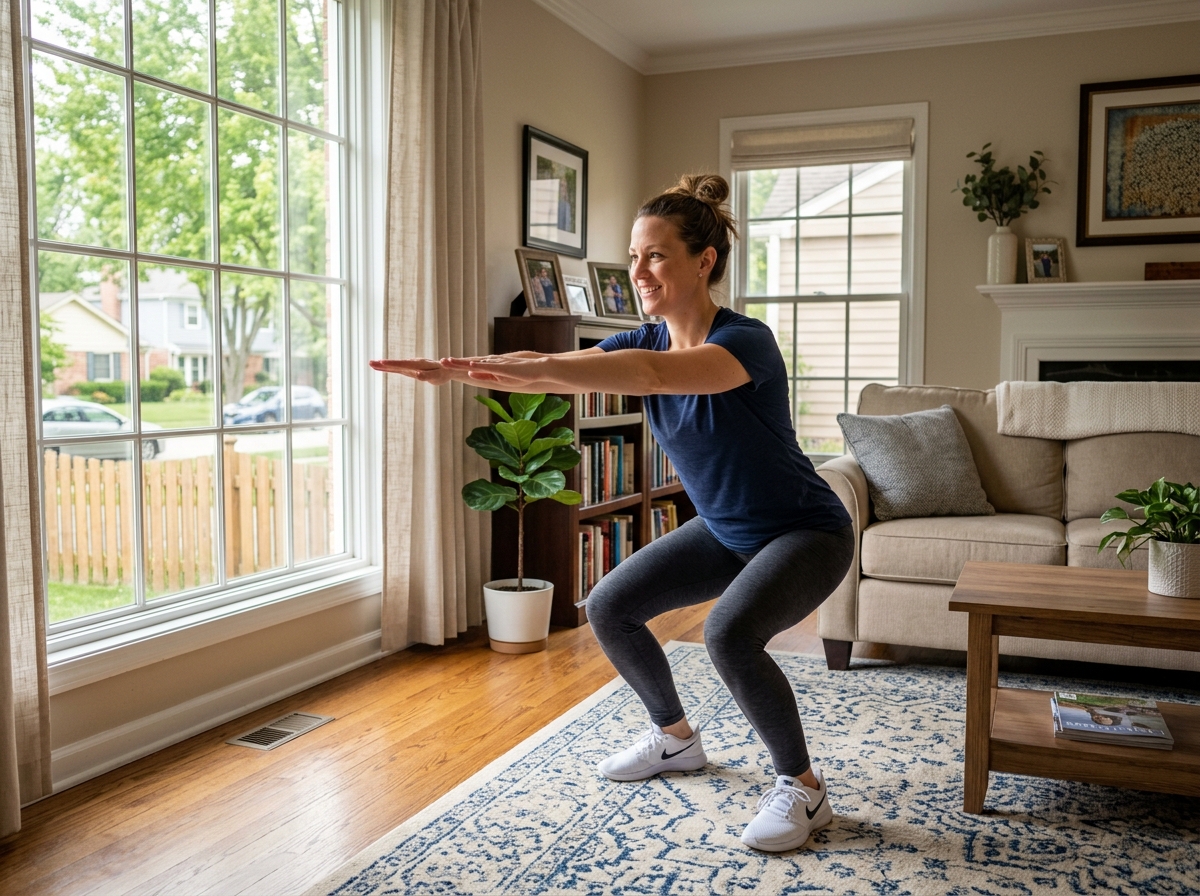
Ready to move? Every workout should follow a specific flow: Warm-up, Conditioning (the main event), and Cool-down.
The Warm-up (3-5 minutes): The goal is to raise your body temperature and prepare your joints. Try dynamic movements like arm circles, marching in place, or light jumping jacks. Research shows that warming up also provides a psychological benefit, “switching” your brain into workout mode.
The Conditioning Phase (15-20 minutes): This is where you perform your main exercises. For beginners, we recommend a circuit style: do one exercise after another with short rests in between.
The Cool-down (3-5 minutes): Never just stop and sit on the couch. Gradually lower your heart rate with some light walking and static stretching (holding a stretch for 20-30 seconds). This helps with flexibility and reduces that next-day soreness.
Here is a sample 1-week schedule to get you started on your-first-home-workout-a-beginners-guide:
| Day | Activity | Duration |
|---|---|---|
| Monday | Full Body Circuit (Strength) | 20 mins |
| Tuesday | Brisk Walk or Light Cardio | 30 mins |
| Wednesday | Full Body Circuit (Strength) | 20 mins |
| Thursday | Rest or Active Recovery (Yoga) | 15 mins |
| Friday | Full Body Circuit (Strength) | 20 mins |
| Saturday | Family Hike or Long Walk | 45 mins |
| Sunday | Full Rest | – |
Sample Exercises for Your First Routine
If you are looking for a Bodyweight Workout for Beginners (20-Minute at Home Routine), focus on these foundational movements. They hit every major muscle group and translate to real-world strength.
- Bodyweight Squats: Stand with feet shoulder-width apart. Sit back like you’re sitting in an invisible chair, keeping your chest up. Push through your heels to stand back up. (10-12 reps)
- Push-ups: Start on your knees if you need to. Keep your core tight and your back flat. Lower your chest toward the floor and push back up. (8-10 reps)
- Walking Lunges: Step forward with one leg and lower your hips until both knees are bent at a 90-degree angle. Step through and repeat on the other side. (10 reps per leg)
- Plank: Hold a push-up position (either on hands or forearms). Keep your body in a straight line from head to heels. This is the ultimate core builder. (Hold for 20-30 seconds)
- Glute Bridges: Lie on your back with knees bent and feet flat. Lift your hips toward the ceiling, squeezing your glutes at the top. (12-15 reps)
Common Mistakes When Starting an Exercise Routine at Home
We’ve all been there—day one is full of excitement, and by day four, we’re too sore to move. Avoid these common pitfalls to stay on track:
- Overtraining: You don’t need to work out for two hours. In fact, doing so as a beginner often leads to burnout. Stick to 20-30 minutes.
- Poor Form: Quality always beats quantity. Doing five perfect push-ups is better for your body than twenty “sloppy” ones. Use a mirror or record yourself on your phone to check your alignment.
- Skipping the Warm-up: This is the fastest way to get an injury. Your muscles are like rubber bands; they stretch better when they’re warm.
- Ignoring Pain: There is a difference between the “burn” of a working muscle and the “sharpness” of an injury. If something hurts in a joint or feels like a pinch, stop immediately.
For more advice on staying safe, check out these beginner-tips-to-stick-to-exercise-routine-at-home.
Fueling and Maintaining Your New Habit
Exercise is only one piece of the puzzle. To see results and feel your best, you need to support your body with proper nutrition and recovery. Think of your body as a high-performance vehicle; you wouldn’t put low-grade fuel in a race car, right?
Hydration: Water is essential for every chemical reaction in your body, including muscle repair. Health guidelines suggest men aim for about 15.5 cups (3.7 liters) and women aim for 11.5 cups (2.7 liters) of fluids daily. If you’re sweating, you’ll need even more.
Nutrition: You don’t need a restrictive diet, but you do need balance.
- Carbs: These are your body’s primary energy source. Eat a small snack with complex carbs (like oatmeal or fruit) before a workout.
- Protein: This is the building block for muscle. Aim for 1.4 to 2.0 grams of protein per kilogram of body weight to help your muscles recover.
- Fats: Healthy fats provide long-lasting energy for lower-intensity activities.
Sleep: This is perhaps the most underrated part of staying-fit-at-home-workouts-for-beginners. Your muscles don’t grow while you’re working out; they grow while you sleep. Aim for 7-9 hours of quality rest per night. For more details on the science of starting out, read How to Start Exercising: A Beginner’s Guide to Working Out.
Staying Motivated for the Long Term
The “honeymoon phase” of a new routine usually lasts about two weeks. After that, discipline has to take over. Here is how we recommend keeping the fire alive:
- The 66-Day Rule: Research suggests it takes an average of 66 days to form a new habit. Commit to just two months of consistency, and it will start to feel like a natural part of your day—like brushing your teeth.
- Variety is the Spice of Fitness: Don’t do the same workout every single day. Swap a strength session for a dance video or a walk in the park.
- Find Your “Why”: Motivation shouldn’t just be about the scale. Are you exercising to have more energy for your kids? To reduce stress? To live longer? Keep that “why” front and center.
- Use Mini-Workouts: On days when you truly don’t have 30 minutes, do 10 minutes. It keeps the habit alive and is far better than doing nothing.
Check out our beginner-tips-to-stick-to-exercise-routine for more psychological tricks to stay consistent.
Frequently Asked Questions about Starting an Exercise Routine at Home
How much exercise do I need each week?
According to the Physical Activity Guidelines, adults should aim for at least 150 minutes of moderate-intensity aerobic activity or 75 minutes of vigorous activity per week. Additionally, you should include at least two days of muscle-strengthening activities that work all major muscle groups (legs, hips, back, abdomen, chest, shoulders, and arms).
Can I build muscle without gym equipment?
Absolutely. Muscle grows through “progressive overload,” which means challenging the muscle more over time. You can do this with bodyweight by increasing your repetitions, decreasing your rest time, or trying harder variations of an exercise (like moving from knee push-ups to full push-ups). You can also use household items like heavy bags or water jugs to add resistance.
How long until I see visible results?
Most people begin to feel better—experiencing improved mood and better sleep—within the first week. Strength gains often become noticeable in 2-4 weeks as your nervous system becomes more efficient. Visible changes in body composition typically take 8-12 weeks of consistent exercise and proper nutrition. It’s a marathon, not a sprint!
Conclusion
Starting an exercise routine at home is one of the most empowering decisions you can make for your health. It’s a commitment to your future self, proving that you don’t need a fancy gym or expensive gadgets to build a stronger, more resilient body. By starting small, setting SMART goals, and focusing on consistency over perfection, you are building a foundation for a sustainable lifestyle.
At NextFin Capital, we believe that health is the ultimate wealth. Just as you would carefully plan your financial future, investing time in your physical well-being pays dividends that last a lifetime. Don’t wait for the “perfect” moment to begin—grab your water bottle, clear a small space in your living room, and take that first step today.
Ready to take your fitness to the next level? Explore more workout routines and find the perfect plan for your journey.
