
Why Starting a Beginner Workout at Home Is Easier Than You Think
Starting a beginner workout at home is one of the simplest, most effective ways to build real fitness habits — no gym membership, no commute, no intimidating equipment required.
Here’s a quick-start overview to get you moving today:
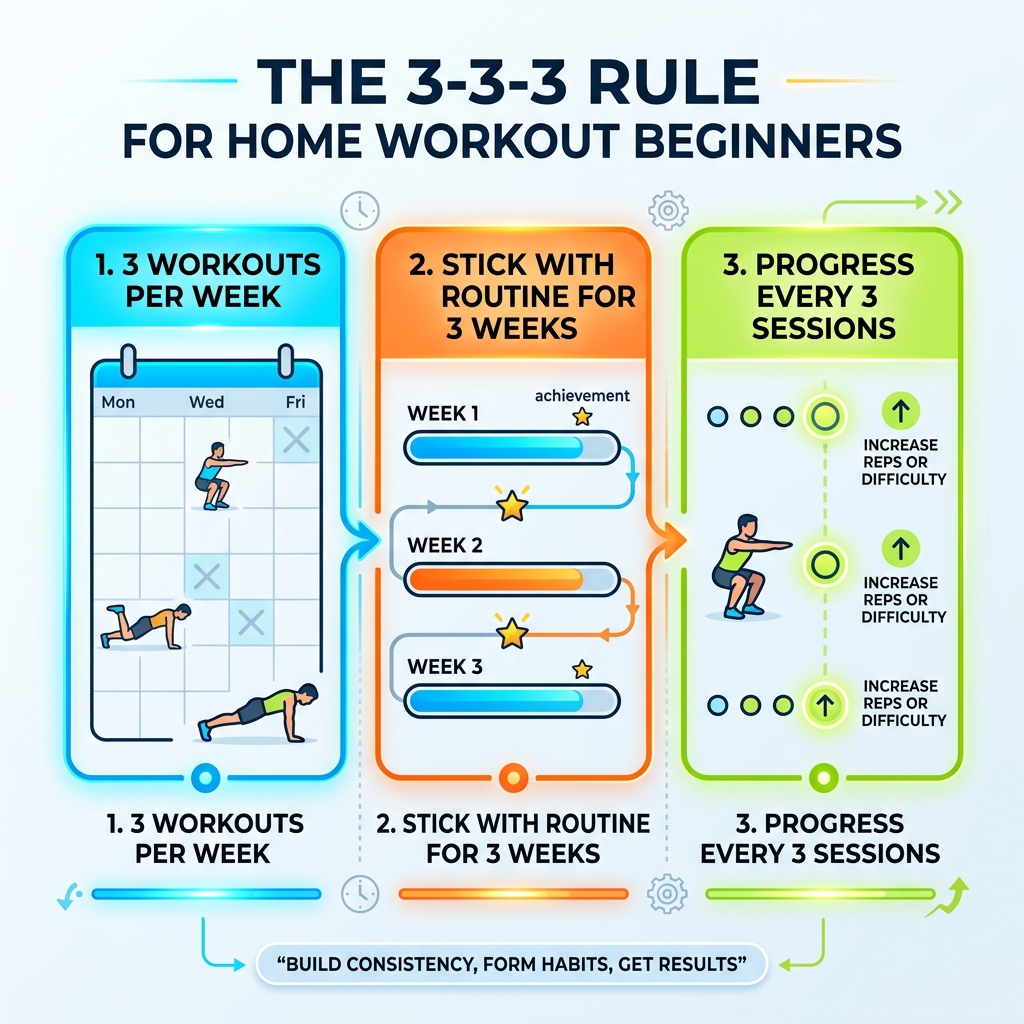
- Aim for 3 days per week — Monday, Wednesday, and Friday work well for most beginners
- Keep sessions to 20 minutes — warm-up, main circuit, and cool-down included
- Use zero equipment — squats, push-ups, lunges, and planks are all you need to start
- Rest 48 hours between strength sessions — your muscles grow during recovery, not during exercise
- Progress gradually — add reps, reduce rest, or try harder variations as you get stronger
Let’s be honest: starting is the easy part. Most people lace up their shoes with great intentions, go too hard on day one, and quit by day three.
The good news? You don’t need to go hard. You just need to be consistent.
Research from the European Journal of Social Psychology found it takes an average of 66 days to form a new habit — meaning the first 30 days are the most critical window for making exercise stick. The best workout plan is one you’ll actually follow.
Whether you’re a busy professional squeezing sessions between meetings or someone picking up exercise for the very first time, this guide walks you through everything — the best exercises, how to structure your week, and how to keep getting results over time.
No fancy equipment. No gym. Just you, a bit of floor space, and a plan that works.
Why a Beginner Workout at Home is Your Best Starting Point
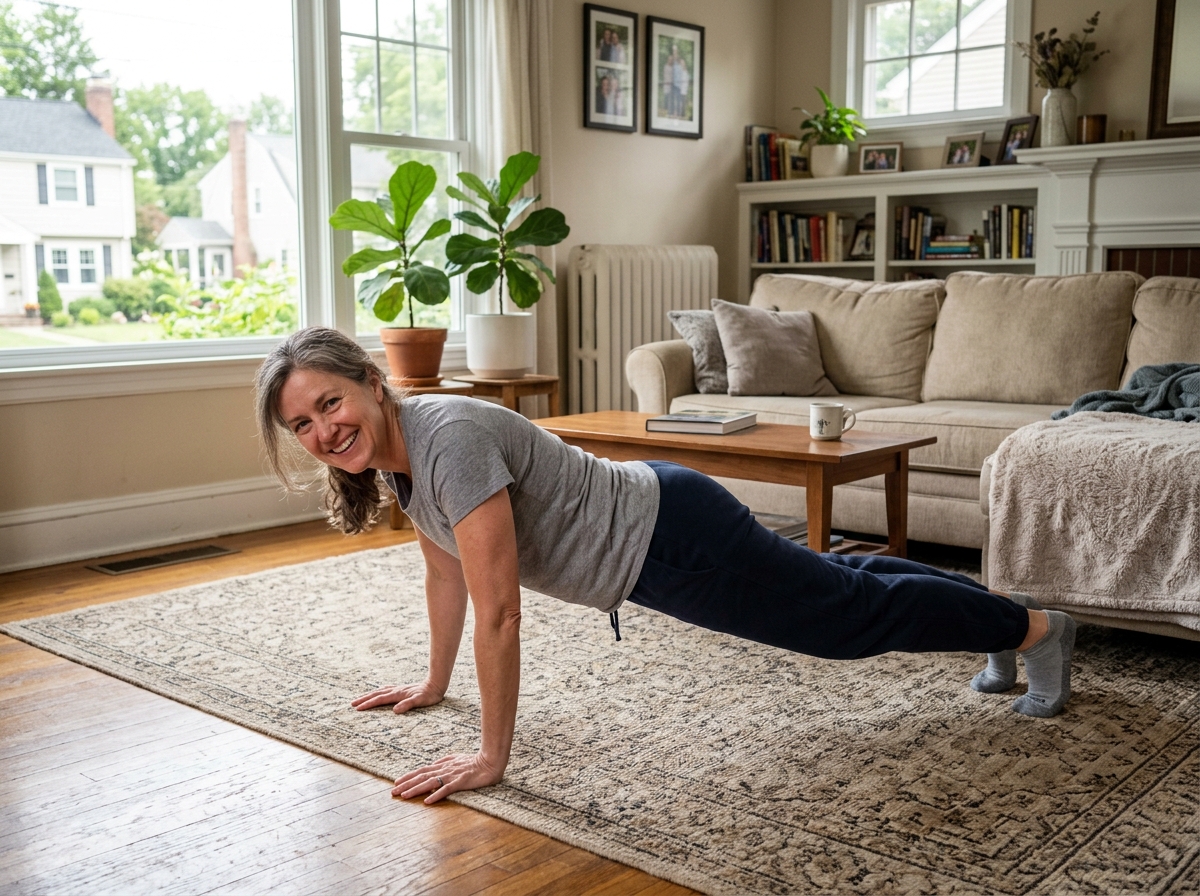
When we think about getting fit, our minds often jump to expensive gym memberships, rows of confusing machines, and the feeling of being watched by fitness pros. But for most of us, the most effective “gym” is actually our living room.
A beginner workout at home offers a level of convenience that a commercial gym simply cannot match. There is no commute, no need to pack a bag, and zero “gym intimidation.” You can exercise in your pajamas if you want to — we won’t tell!
Beyond convenience, home workouts are incredibly cost-effective. In 2021, consumer expenditures for athletic gear and exercise equipment doubled, but you don’t need to spend a cent to see results. Bodyweight training is a science-backed way to improve your health. The Physical Activity Guidelines for Americans recommend that adults get at least 150 minutes of moderate-intensity exercise per week, plus muscle-strengthening activities at least twice a week. You can meet every single one of those requirements right on your carpet.
Furthermore, home exercise is excellent for joint health and longevity. For those of us dealing with minor aches, being in a comfortable environment allows us to focus on form without pressure. In fact, some programs have shown that members experience up to a 68% reduction in pain within the first 12 weeks of consistent, low-impact movement. For more on the fundamentals, check out the-beginners-manual-to-home-workouts.
Overcoming Common Barriers
We often hear that “time” is the biggest hurdle to fitness. We get it — between work, family, and trying to have a social life, an hour-long workout feels impossible. This is where the beauty of a beginner workout at home shines.
We recommend “movement snacks.” These are short, 5-to-10-minute bursts of activity throughout the day. Research shows that these micro-workouts can boost strength and endurance just as effectively as one long session for many beginners. If you can’t find 30 minutes, find three 10-minute windows. Squat while the coffee brews, or hold a plank during a commercial break. To learn more about fitting fitness into a hectic life, read our guide on staying-fit-at-home-workouts-for-beginners.
The Effectiveness of Bodyweight Training
Can you actually build muscle and lose fat without lifting heavy iron? Absolutely. Bodyweight exercises use your own mass as resistance. By changing the angle of your body or the speed of your movements, you can make an exercise significantly harder.
Muscle building occurs through “progressive overload.” This just means challenging your muscles more over time. At home, we do this by adding more repetitions, decreasing our rest time, or moving to a more difficult version of an exercise (like moving from knee push-ups to full push-ups). As for fat loss, while nutrition is the biggest piece of the puzzle, strength training helps preserve your muscle mass while you’re in a calorie deficit, giving you that “toned” look everyone is after.
Essential Exercises for Your Beginner Workout at Home
To build a balanced body, we focus on “functional fitness.” These are movements that translate to real life — like picking up a heavy box (a squat) or pushing a heavy door (a push-up). By mastering these compound movements, which use multiple muscle groups at once, we get the most “bang for our buck” in every session. For a deeper dive into these movements, see our article on effective-home-workouts-for-beginners.
Lower Body Fundamentals: Squats and Lunges
The legs are the engine of the body. Training them burns the most calories and builds a solid foundation.
- Chair Squats: If a standard squat feels scary, start with a chair. Stand in front of it, lower your hips until they just touch the seat, and stand back up. This teaches you to keep your weight in your heels.
- Reverse Lunges: We prefer reverse lunges for beginners because they are often easier on the knees than forward lunges. Step back, lower your back knee toward the floor, and push off your front foot to return to standing.
- Glute Bridges: Lie on your back with knees bent and feet flat on the floor. Lift your hips toward the ceiling, squeezing your glutes at the top. This is vital for counteracting the effects of sitting all day.
Starting your lower body journey is a key step in weight loss. Explore more at home-workouts-a-beginners-journey-to-weight-loss.
Upper Body Strength for a Beginner Workout at Home
You don’t need a bench press to build a strong chest, back, and shoulders.
- Incline Push-ups: If a floor push-up is too hard, place your hands on a sturdy kitchen counter or the back of a sofa. The higher your hands are, the easier the move becomes.
- Dumbbell Rows (with household items): Find a gallon jug of water or a milk jug. Lean over a table for support and pull the weight toward your hip. This works the muscles of your back and improves your posture.
Core Stability for a Beginner Workout at Home
A strong core isn’t just about six-pack abs; it’s about protecting your spine.
- Forearm Plank: Hold yourself up on your forearms and toes (or knees). Keep your body in a straight line. Avoid letting your hips sag!
- Bird Dog: On all fours, extend your right arm and left leg simultaneously. This builds balance and stability.
- Dead Bug: Lie on your back and slowly lower opposite arms and legs toward the floor. It sounds funny, but it’s one of the best ways to teach your core to stay braced.
For a quick daily hit, try our 10-minute-daily-workout-routine-for-beginners.
Structuring Your Routine for Long-Term Success
How you put these exercises together matters. For beginners, we highly recommend circuit training. This means doing one set of each exercise back-to-back with minimal rest, then resting for a minute or two before repeating the whole loop. This keeps your heart rate up, giving you a cardio boost while you build strength.
| Feature | Beginner Level | Intermediate Level |
|---|---|---|
| Sets | 2 Rounds | 3-4 Rounds |
| Reps | 8-12 Reps | 15-20 Reps |
| Rest Between Moves | 30-45 Seconds | 10-15 Seconds |
| Rest Between Rounds | 2 Minutes | 1 Minute |
The goal is to focus on form first. Once you can perform the movements perfectly, you can increase the intensity. For a step-by-step walkthrough, read your-first-home-workout-a-beginners-guide.
Frequency and Duration
You don’t need to live in your workout gear. As mentioned, 150 minutes of moderate activity per week is the “gold standard” for health. We suggest breaking this down into three 20-to-30-minute full-body sessions.
Crucially, you should allow for 48 hours of rest between sessions that target the same muscle groups. If you work your whole body on Monday, wait until Wednesday to do it again. Your muscles actually repair and grow stronger while you sleep, not while you’re sweating! Learn more about planning your journey at starting-your-weight-loss-journey-with-home-workouts.
The Importance of Warm-Ups and Cool-Downs
Skipping the warm-up is the most common beginner mistake. A dynamic warm-up (moving while stretching) wakes up your nervous system and lubricates your joints. Think of it like warming up a car engine in the winter.
- Warm-up (5 mins): March in place, do arm circles, and perform “air” versions of the exercises you’re about to do.
- Cool-down (5 mins): This is the time for static stretching (holding a stretch). This helps lower your heart rate and can reduce muscle soreness the next day.
Maximizing Results with Nutrition and Recovery
We have a saying in the fitness world: “You can’t out-train a bad diet.” While a beginner workout at home is essential for health, nutrition is responsible for at least 80% of your body composition results.
The 80/20 Rule and Protein Priority
We don’t believe in restrictive diets that make you miserable. Instead, follow the 80/20 rule: eat whole, nutritious foods 80% of the time, and enjoy your favorite treats the other 20%.
To support muscle growth and keep you feeling full, prioritize protein. Aim for a palm-sized portion of protein (chicken, beans, tofu, eggs) at every meal. If your goal is weight loss, you must be in a slight calorie deficit, but keeping your protein high ensures you lose fat, not muscle. For more fat-burning tips, check out burn-fat-with-a-beginners-home-workout.
Tracking Progress and Scaling Difficulty
Don’t just rely on the scale. Weight can fluctuate based on water, salt, and hormones. Instead, track your “non-scale victories”:
- Tempo: Can you lower yourself into a squat more slowly and under control?
- Rep Increases: Did you do 12 push-ups today when you could only do 10 last week?
- Harder Variations: Have you graduated from wall push-ups to incline push-ups?
Tracking these small wins keeps the motivation high. See our beginners-guide-to-losing-weight-with-home-exercises for more tracking strategies.
Frequently Asked Questions about Home Fitness
Can I build muscle with just bodyweight exercises?
Yes! While many think you need heavy weights for hypertrophy (muscle growth), your muscles only recognize tension. By using “time under tension” — such as taking 3 seconds to lower yourself in a squat — you create the stimulus needed for growth. As you get stronger, you can move to more challenging variations to keep the progress going.
How often should a beginner work out each week?
Three days a week is the “sweet spot” for most beginners. This allows for non-consecutive training days (e.g., Mon/Wed/Fri), giving your body the 48 hours it needs to recover. On your “off” days, we recommend “active recovery,” such as a 20-minute walk or some light stretching. This keeps you in the habit of moving without overtaxing your system. For a kickstart, see kickstart-your-weight-loss-with-a-home-workout.
What equipment is absolutely necessary to start?
Technically? Zero. You can have a world-class beginner workout at home using nothing but the floor. However, as you progress, you might want to incorporate household items like water jugs for resistance or a sturdy chair for balance. Eventually, a cheap set of resistance bands can add a lot of variety for a very low cost. Check out these simple-exercise-routines-for-weight-loss-at-home for more ideas.
Conclusion
At NextFin Capital, we believe that fitness should be accessible, sustainable, and, most importantly, effective. Starting a beginner workout at home isn’t just about looking better in a t-shirt; it’s about building the functional strength you need to live a vibrant, healthy life.
By focusing on consistency over intensity, mastering the foundational movements, and supporting your hard work with smart nutrition, you are setting yourself up for long-term success. It’s not about being perfect; it’s about being better than you were yesterday.
Ready to take the next step? Dive into our home-workouts-for-beginners-a-comprehensive-guide or Explore Our Full Library of Workout Routines to find the perfect plan for your goals. Let’s get moving!
