
Why Chair Yoga for Seniors Is the Smartest Way to Stay Active at Home
Chair yoga for seniors is one of the most accessible, low-impact ways to build strength, flexibility, and balance — all from the comfort of a sturdy chair.
Here’s a quick overview of what it offers:
- What it is: A gentle form of yoga performed while seated or using a chair for support
- Who it’s for: Seniors, beginners, or anyone with limited mobility or joint concerns
- Key benefits: Improved flexibility, better balance, reduced chronic pain, and stress relief
- What you need: Just a sturdy chair, comfortable clothes, and 10 minutes a day
- How often: Daily or 3-5 times per week for best results
As we age, staying active gets harder — not because the will disappears, but because the body’s demands change. Joints get stiffer. Balance becomes less reliable. Traditional workouts can feel intimidating or even risky.
That’s exactly where chair yoga steps in.
It takes the proven benefits of traditional yoga — flexibility, strength, mindfulness — and adapts them for people who need a safer, more supported approach. Research backs this up: a 2019 study found that just 12 weeks of chair yoga improved strength, balance, agility, and flexibility in older adults.
And the best part? You don’t need a gym, a mat, or any prior yoga experience.
This guide walks you through everything — from the basic poses to full routines — so you can start moving better today.

What is Chair Yoga for Seniors and Why Does It Work?
At its core, chair yoga for seniors is a modified version of Hatha yoga. While traditional yoga often requires getting up and down from the floor—a task that can be daunting or even painful for those with knee or hip issues—chair yoga brings the practice to you. By using a chair as a prop, we can replicate almost any standing or floor-based pose while maintaining total stability.
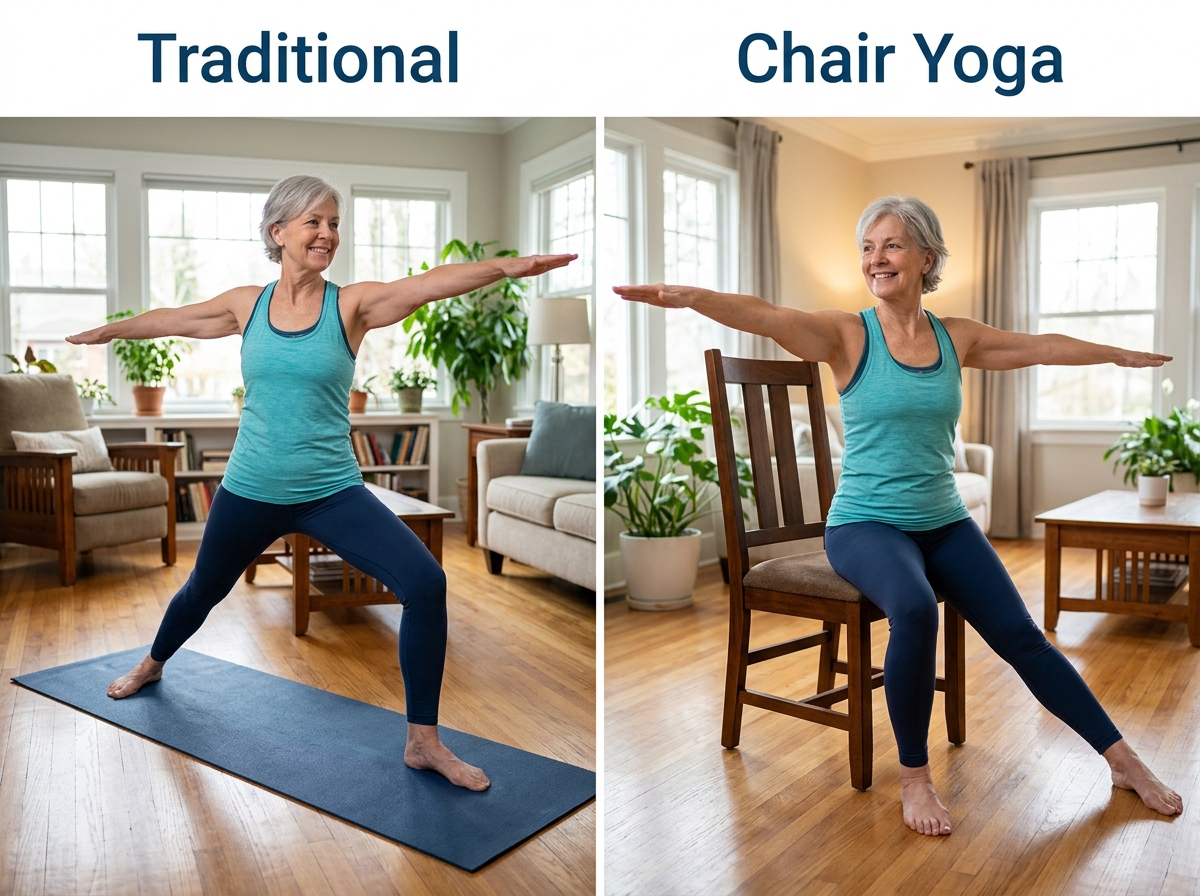
Traditional Yoga vs. Chair Yoga
The primary difference lies in the “base of support.” In traditional yoga, your balance is often tested on a thin mat. In chair yoga, the seat provides a constant point of contact, allowing the muscles to stretch and strengthen without the fear of falling. This makes it a joint-friendly alternative that focuses on functional fitness—the kind of movement that helps you reach for a high shelf or tie your shoes with ease.
| Feature | Traditional Yoga | Chair Yoga |
|---|---|---|
| Impact Level | Low to Moderate | Very Low |
| Balance Requirement | High | Low (Supported) |
| Accessibility | Requires floor mobility | Accessible to all mobility levels |
| Equipment | Mat, blocks, straps | Sturdy chair, optional props |
| Core Engagement | High | Moderate to High |
Beyond the chair itself, many practitioners find that adding a few simple tools can enhance the experience. If you are curious about how to further support your body, you can find more info about yoga props to help customize your seated practice.
Essential Health Benefits for Older Adults
Why is everyone talking about chair yoga for seniors? Because it addresses the specific physiological changes that occur as we blow out more candles on our birthday cakes.
Physical Strength and Gait
Science is firmly on the side of the seated yogi. A 2019 study of 31 older females demonstrated that 12 weeks of consistent chair yoga significantly improved strength in the hands, arms, and legs. This translates to better “gait”—the way you walk—which is a primary indicator of overall health in seniors. You can read more about how these basic poses improve flexibility and strength to see the data for yourself.
Fall Prevention and Balance
Falls are a leading concern for those over 65. Chair yoga builds “proprioception”—the body’s ability to sense its position in space. By strengthening the core and the small stabilizer muscles in the ankles and hips, we create a sturdier foundation.
Relief for Chronic Conditions
- Arthritis: Gentle movement lubricates the joints and reduces the stiffness associated with osteoarthritis. A 2023 study of women with knee osteoarthritis found that 12 weeks of chair yoga significantly improved their functional fitness.
- Osteoporosis: While we must be careful with deep spinal twists (more on that later), weight-bearing seated poses help maintain bone density safely.
- Mental Clarity: Yoga isn’t just for the body; it’s a “brain break.” The focus on breathing helps reduce cortisol (the stress hormone), leading to better sleep and improved memory.
Getting Started: Equipment and Safety Precautions
One of the best things about chair yoga for seniors is the low barrier to entry. You don’t need fancy spandex or a gym membership. However, safety is our number one priority.
The Right Chair
Your “yoga studio” starts with the chair.
- Stability: Use a sturdy chair without wheels. Folding chairs or dining chairs work well.
- No Arms (Ideally): An armless chair allows for a greater range of motion during side stretches and twists.
- Surface: Place your chair on a non-slip surface. While the chair is your main tool, having one of the best yoga mats for stability underneath the chair legs can prevent it from sliding on hardwood or tile.
Safety Tips to Remember
- Listen to Your Body: If a movement causes sharp pain, stop immediately. Discomfort is okay; pain is a “no-go” zone.
- Consult Your Doctor: Especially if you have had recent surgery, heart conditions, or severe osteoporosis.
- Hydrate: Keep water nearby. Even low-impact exercise requires hydration.
- Smooth Transitions: Move slowly. Moving too fast can lead to dizziness, especially if you have blood pressure fluctuations.
Step-by-Step Guide to Beginner Chair Yoga for Seniors Poses
Now, let’s get moving! Before you start, take a moment to “center” yourself. Sit toward the front edge of your chair so your back is away from the backrest. Plant your feet firmly on the floor, hip-width apart.
Focus on your breath. Inhale through your nose, feeling your ribs expand, and exhale slowly. This simple act of breathing engages your pelvic floor and core, providing the stability you need for the poses ahead. For a quick mental reset, you can follow this 15-minute reset routine which emphasizes visualization and tension release.
Foundational Chair Yoga for Seniors Poses for Flexibility
These poses are designed to “wake up” the spine and improve the range of motion in your neck and shoulders.
- Seated Mountain Pose (Tadasana): This is your home base. Sit tall, shoulders down, hands resting on your thighs. Imagine a string pulling the crown of your head toward the ceiling. Hold for 5-10 deep breaths.
- Seated Cat-Cow Stretch: Place your hands on your knees. As you inhale, arch your back and look slightly upward (Cow). As you exhale, round your spine and tuck your chin toward your chest (Cat). Repeat 5-8 times to ease back pain.
- Neck Rolls: Slowly drop your right ear to your right shoulder. Hold for two breaths. Roll your chin to your chest, then move your left ear to your left shoulder. This is a lifesaver for “tech neck.”
- Seated Forward Fold: Inhale to lengthen your spine. On the exhale, hinge at your hips and slowly lower your chest toward your thighs. Let your hands dangle toward your feet. This triggers the “rest-and-digest” response, calming the nervous system.
If you’re looking for a structured way to start your day, these 10-minute flow instructions offer a great visual guide.
Strengthening Chair Yoga for Seniors Poses for Balance
Strength is the secret to independence. These poses target the large muscle groups in your legs and core.
- Seated Leg Lifts: While sitting tall, straighten your right leg and lift it a few inches off the floor. Flex your toes toward your face. Hold for 3 seconds, then lower. Repeat 10 times per leg. This strengthens the quadriceps and hip flexors.
- Warrior II (Seated Adaptation): Turn your body to the right, sitting so your right thigh is supported by the chair and your left leg extends out to the side (or stays bent if that’s more comfortable). Extend your arms out like wings and gaze over your right hand. This builds shoulder strength and hip flexibility.
- Goddess Pose: Open your knees wide and point your toes outward. Press your feet into the floor and lift your heels one at a time. This targets the inner thighs and calves.
- Seated March: This is great for cardiovascular health. Simply lift your knees alternately as if you are marching in place while seated. Do this for 60 seconds to get the blood flowing.
For those who want to ensure their feet have a soft, stable place to land during these movements, check out more info about beginner mats to protect your joints.
Sample Routines: From 10-Minute Flows to 28-Day Challenges
Consistency beats intensity every single time. You don’t need to practice for an hour to see results.
The 10-Minute Daily Reset
- Minutes 1-2: Centering and deep breathing in Mountain Pose.
- Minutes 3-5: Cat-Cow and Neck Rolls to loosen the spine.
- Minutes 6-8: Seated Leg Lifts and Seated March for strength.
- Minutes 9-10: Forward Fold and a final moment of gratitude.
The 28-Day Chair Yoga Challenge
If you thrive on structure, a 28-day challenge is a fantastic way to build a habit. About 11,000 people search for “28-day chair yoga for seniors free” on Pinterest every month because it works!
- Week 1: Focus on breathing and basic flexibility (Cat-Cow, Side Stretches).
- Week 2: Introduce strength (Leg Lifts, Warrior poses).
- Week 3: Work on balance and coordination (Goddess pose, Eagle arms).
- Week 4: Combine all poses into a fluid 15-minute daily flow.
Many seniors find community engagement through programs like SilverSneakers, which offer instructor-led classes. These social connections are just as important for wellness as the physical exercise itself, as they help combat the loneliness that can sometimes come with aging.
Frequently Asked Questions about Chair Yoga
How often should seniors practice chair yoga for best results?
We recommend aiming for at least 5–10 minutes daily. If that feels like too much, start with 3 sessions per week. Consistency is what builds the muscle memory and flexibility that lead to long-term health.
Can chair yoga help with specific conditions like arthritis or osteoporosis?
Absolutely. Chair yoga is often recommended by healthcare providers because it is low-impact. For arthritis, it helps maintain joint mobility. For osteoporosis, it provides a safe way to engage in weight-bearing exercises (through the feet and arms) without the risk of falling. However, if you have osteoporosis, avoid deep, rapid spinal twists or extreme forward bends.
Do I need special equipment or a specific type of chair?
No special equipment is required! A standard kitchen or dining room chair is perfect. Just ensure it doesn’t have wheels or swivel. If you find the seat is too hard, you can place a small cushion or a folded yoga mat on it for comfort.
Conclusion
Embracing chair yoga for seniors is about more than just “stretching.” It is an investment in your physical vitality and mental sharpness. By taking just a few minutes each day to move mindfully, you are protecting your independence and ensuring that you can continue to enjoy the activities you love—whether that’s gardening, traveling, or playing with your grandkids.
At NextFin Capital, we believe that wellness should be accessible to everyone, regardless of age or ability. Taking care of your body today ensures a brighter, more active tomorrow. If you’re ready to take the next step in your fitness journey, explore fitness gear for seniors to find the tools that will support your new routine.
Namaste, and happy stretching!
