
Why Starting Cardio at Home Is Easier Than You Think
Cardio for beginners at home is one of the most accessible ways to improve your health — no gym membership, no expensive equipment, and no commute required.
Here’s a quick snapshot of what you need to know to get started:
- What it is: Any rhythmic movement that raises your heart rate above resting for at least 10 minutes
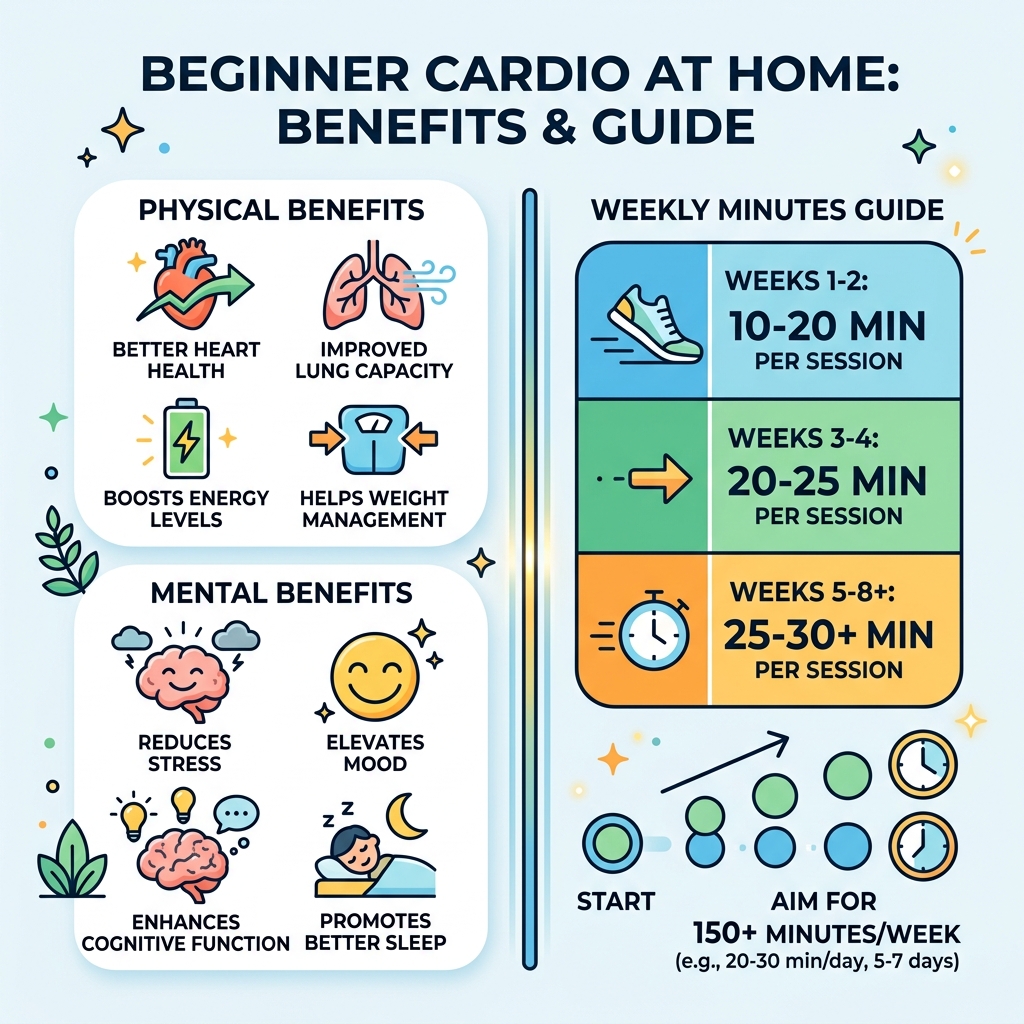
- How much: Aim for 150 minutes of moderate activity per week (about 20-30 minutes a day)
- Best starting exercises: Walking in place, marching, jumping jacks, lateral shuffles, and bodyweight squats
- How long per session: Start with 10-20 minutes, 2-3 times per week
- Equipment needed: None — just comfortable clothes and non-skid shoes
- Key principle: Consistency beats intensity every single time for beginners
If you’re a busy professional who wants to get healthier but can’t carve out time for gym visits, you’re not alone. Most people quit early because they try to do too much, too fast.
The good news? You don’t need to. Short, simple workouts done consistently at home can deliver real results — for your heart, your energy levels, and your mental well-being.
This guide breaks everything down step by step, so you know exactly where to start and how to build from there.
Understanding Cardio for Beginners at Home
When we talk about “cardio,” we are referring to cardiovascular or aerobic exercise. In simple terms, this is any rhythmic activity that increases your heart rate and breathing for a sustained period. During this process, your heart, lungs, and blood vessels work together to deliver oxygen-rich blood to your working muscles.
For those of us just starting out, understanding the “why” and “how much” is the first step toward success. According to the Physical Activity Guidelines for Americans and the American Heart Association, adults should aim for:
- 150 to 300 minutes of moderate-intensity aerobic exercise per week (like brisk walking).
- OR 75 to 150 minutes of vigorous-intensity exercise (like running or HIIT).
If those numbers sound intimidating, don’t worry. You can break them down into manageable chunks. Even 20 to 30 minutes a day, or several 10-minute “micro-workouts” throughout the day, can help you reach these goals.
Starting a Cardio Workout Program for Beginners is about more than just burning calories. Consistent cardio strengthens your immune system, boosts your stamina, and helps manage health conditions like high blood pressure, diabetes, and heart disease. Perhaps most importantly for those with busy lives, it releases endorphins—those “feel-good” chemicals—that reduce stress and improve mental clarity.
Best Low-Impact Exercises to Start Today
One of the biggest misconceptions about cardio for beginners at home is that you need to be jumping around or running in place to see results. In reality, low-impact exercises are often the best place to start because they are joint-friendly and carry a lower risk of injury.

If you are just getting off the couch after a long hiatus, we recommend starting with these equipment-free movements:
- Marching in Place: A classic for a reason. Lift your knees high and swing your arms to get the blood flowing.
- Arm Circles: While standing or marching, extend your arms and make small circles. It sounds simple, but it effectively raises the heart rate by engaging the upper body.
- Single Leg Stands: Great for balance and core engagement while keeping the heart rate steady.
- Standing Hamstring Curls: Kick your heels back toward your glutes while standing. This targets the back of your legs and keeps you moving without any impact on your joints.
- Lateral Shuffles: Step side-to-side in your living room. This move improves coordination and works your hips.
For a guided experience that avoids the stress of jumping, you can follow along with this 15 MIN BEGINNER CARDIO WORKOUT (No Jumping). These types of workouts prove that you can get sweaty and breathless without ever leaving the floor.
Simple Cardio for Beginners at Home Movements
As you get comfortable, you can mix in more dynamic movements. The key here is form control and core engagement. Don’t rush; focus on doing the move correctly rather than doing it quickly.
- Heel Taps: Reach your foot forward and tap your heel on the ground while slightly bending your opposite knee.
- Sumo Squats with a Reach: Take a wide stance, squat down, and as you stand up, reach your arms toward the ceiling. This stabilizes the hips and pelvic floor.
- Jabs and Taps: Channel your inner boxer. Punch forward (jabs) while tapping your toes to the side.
- Step-out Burpees: Traditional burpees involve jumping, but beginners should start by stepping back into a plank and stepping back up. It’s a full-body burner without the impact.
- Modified Jumping Jacks: Instead of jumping, step one foot out to the side while raising your arms, then bring it back and switch sides.
How to Structure Your Home Workout Routine
To make progress, you need a plan. Most home workouts follow one of two formats: Steady State (keeping a consistent pace) or HIIT (High-Intensity Interval Training).
| Feature | Steady State Cardio | HIIT (Interval Training) |
|---|---|---|
| Intensity | Low to Moderate | High (Short Bursts) |
| Duration | 20–40 minutes | 10–20 minutes |
| Best For | Building an aerobic base | Burning calories quickly |
| Example | Brisk walking in place | 30s jumping jacks / 30s rest |
For beginners, we often recommend a circuit training approach. This keeps the workout interesting and allows for built-in recovery. A great starting point is this 10-Minute Beginner Cardio Workout (Video), which uses timed intervals to keep you moving.
A typical structure might look like this:
- Warm-up (5 minutes): Light marching, arm circles, and torso rotations to prep the muscles.
- The Circuit (10–20 minutes): Perform 4-5 exercises back-to-back.
- 30/30 Intervals: 30 seconds of work followed by 30 seconds of rest.
- 40/20 Intervals: As you get fitter, move to 40 seconds of work and 20 seconds of rest.
- Cool-down (5 minutes): Slow movements and static stretching (holding a stretch for 20-30 seconds) to help your heart rate return to normal and prevent stiffness.
Measuring Intensity in Cardio for Beginners at Home
How do you know if you’re working hard enough—or too hard? You don’t need a fancy smartwatch to track your effort. We recommend two simple methods:
1. The RPE Scale (Rate of Perceived Exertion) Rank your effort on a scale of 1 to 10:
- 1–2: Very easy (like sitting or slow walking).
- 3–4 (Moderate): You’re breathing harder but can still hold a steady conversation. This is the “sweet spot” for beginners.
- 5–7 (Vigorous): You can only speak a few words at a time.
- 8–10: Max effort, breathless. (Avoid this when starting out!)
2. The Talk Test If you can sing a song, you aren’t working hard enough. If you can talk but need to pause for breath every few sentences, you’re in the perfect moderate-intensity zone. If you can’t speak at all, back off a little.
If you prefer data, use the “220 minus age” formula to find your estimated maximum heart rate. Beginners should aim to stay between 50% and 70% of that number.
Safety Precautions and Common Mistakes to Avoid
Before you start your first session of cardio for beginners at home, safety must be your priority. We want you to stay consistent for years, not just for a week before getting injured.
1. Consult a Physician This is critical if you have a history of heart disease, high blood pressure, diabetes, or joint issues. If you fall into the 45+ age bracket or have a family history of heart issues, get a professional “all-clear” first.
2. Prepare Your Space Clear a 6×6 foot area. Check for loose rugs that might slide and ensure you have enough overhead clearance for arm movements.
3. Wear Proper Footwear Even though you are at home, don’t work out in socks on a hardwood floor—you’ll slip! Wear non-skid athletic shoes to support your arches and provide traction.
4. Avoid the “All-In” Trap A common mistake is trying a 4-Move Beginner Cardio Workout You Can Do at Home and doing 10 rounds on the first day. This leads to extreme soreness and quitting. Start with 2-3 rounds and see how you feel the next day.
5. Hydrate Don’t wait until you’re thirsty. Aim for a steady intake of water throughout the day. Men generally need about 15.5 cups and women about 11.5 cups of total fluids daily, though this varies based on your activity level.
Frequently Asked Questions about Home Cardio
Is 10 minutes of cardio enough for a beginner?
Absolutely. In the fitness world, we call these “micro-workouts.” If you are currently doing zero minutes of exercise, 10 minutes is a massive improvement. Research shows that three 10-minute sessions spread throughout the day offer similar health benefits to one 30-minute session. The goal is to build the habit of movement first. Once 10 minutes feels easy, add two minutes to your next session.
Do I need expensive equipment to start?
No. Your own body weight is the most effective tool you have. Gravity provides all the resistance you need for squats, lunges, and jacks. If you want to invest in anything, a simple yoga mat for floor work and a pair of supportive shoes are plenty. You can even use household items, like water bottles as light weights, once you progress past the absolute beginner stage.
How often should I do cardio each week?
For total beginners, we recommend 2 to 3 days a week on nonconsecutive days (e.g., Monday, Wednesday, Friday). This gives your muscles and joints time to recover and adapt. As your stamina improves, you can gradually increase to 4 or 5 days a week. Remember the CDC recommendation of 150 minutes—how you divide that up is entirely up to your schedule.
Conclusion
Starting a journey with cardio for beginners at home is one of the kindest things you can do for your future self. It’s not about having the perfect form or the most expensive gear; it’s about showing up in your living room and moving your body for a few minutes every day.
At NextFin Capital, we believe that health is the ultimate long-term investment. Just like financial planning, fitness requires a solid foundation, a bit of patience, and the willingness to celebrate small victories along the way. Whether you managed five minutes of marching today or completed your first full circuit, you are moving in the right direction.
Ready to take the next step in your fitness journey? Explore more workout routines and find the plan that fits your lifestyle. Your transformation starts exactly where you are right now.
