
You Can Work Your Core Without Leaving Your Chair
A 10 minute chair workout for beginners is a short, seated exercise routine that strengthens your core, legs, and upper body — no gym, no floor work, and no special equipment required.
Here’s what a basic 10-minute beginner chair workout looks like:
- Seated marches – lift alternating knees to warm up hips and core
- Chair squats – stand and sit with control to work legs and glutes
- Seated leg extensions – straighten each leg to target the quads
- Seated rows – pull elbows back to strengthen the upper back
- Oblique twists – rotate side to side to engage the deep core
- Shoulder rotations – loosen and strengthen the shoulders
- Seated calf raises – lift heels to improve ankle strength and balance
All you need is a sturdy chair and 10 minutes.
Staying active when you’re busy is hard. Gym memberships, commutes, and complicated routines get in the way. But here’s the thing — you don’t need any of that to build real strength.
Chair-based exercise is one of the most accessible forms of fitness available. It’s low-impact, joint-friendly, and proven to deliver results. Research shows that after just 8 weeks of chair-based exercise, older adults experienced reduced pain, less fatigue, and improved movement speed. And that’s with no floor work, no weights, and no gym.
Whether you’re new to exercise, dealing with limited mobility, or simply short on time — this kind of workout meets you exactly where you are.
Why a 10 Minute Chair Workout for Beginners is a Game Changer
We often think of fitness as something that requires sweat, heavy weights, and a lot of standing. However, for many of us, standing for long periods or getting down on a yoga mat is either uncomfortable or impossible. That is where the 10 minute chair workout for beginners steps in to save the day. It isn’t just a “modified” version of exercise; it is a powerful tool for maintaining our health and independence.
A challenge we face as we age is a condition called sarcopenia. This is the natural loss of muscle mass that occurs over time. In fact, adults over the age of 50 lose muscle mass at a rate of about 1% per year if they aren’t actively working against it. Even more surprising is that our “power”—our ability to generate force quickly—is lost at roughly twice that rate.
A consistent chair routine helps us fight back against these statistics. By engaging in effective home workouts for beginners, we can preserve our muscle tone and keep our joints moving smoothly. Speaking of joints, chair-based movement is incredibly kind to them. Research on chair yoga for osteoarthritis relief has shown that people with lower extremity osteoarthritis experience significant improvements in daily activities and overall fitness after just 12 weeks of consistent seated exercise.
Beyond the numbers, these workouts provide functional independence. When we strengthen our quadriceps and glutes from a seated position, we are actually practicing the exact movements we need to get up from a low sofa, climb stairs, or step out of a car. It’s about making everyday life feel easier and more joyful.
Essential Equipment and Safety Tips for Seated Success
Before we dive into the movements, we need to make sure our “home gym” is safe and effective. You don’t need a fancy bench, but you do need to be smart about your setup.
Choosing Your Chair
The most important piece of equipment is, obviously, the chair. We recommend a sturdy, high-backed chair without wheels. Folding chairs or dining chairs work great. Avoid anything too soft, like a plush recliner, as it won’t provide the support you need for your spine. Ensure the chair is placed on a non-slip surface, like a rug or a yoga mat, so it doesn’t slide away from you mid-move.
Finding Your “Seated Sweet Spot”
Posture is everything in a 10 minute chair workout for beginners. We like to call the ideal posture the “seated sweet spot.” This means sitting toward the front third of the chair so your back isn’t leaning against the rest. Your feet should be planted firmly on the floor, hip-width apart, with your knees directly over your ankles. Imagine a string pulling the crown of your head toward the ceiling—this creates a long, tall spine and engages your core naturally.
Breathing and Mindset
We always emphasize diaphragmatic breathing, or “belly breathing.” Instead of taking shallow breaths in your chest, try to breathe deeply into your abdomen. This helps stabilize your core and keeps your blood pressure steady during exercise.
Safety First
We want you to feel the “work,” but never the “pain.” There is a big difference between a muscle feeling tired and a joint feeling sharp pain. If you feel any sharp, stabbing, or sudden pain, stop immediately. We also suggest consulting with a healthcare professional before starting any new routine, especially if you have chronic conditions or balance issues. For more tips on getting started safely, check out our guide on setting up your first home gym.
The Best Exercises for Your Seated Routine
Now, let’s get moving! A well-rounded 10 minute chair workout for beginners should target all the major muscle groups. We’ve selected these specific moves because they are high-impact for your health but low-impact on your joints.
1. Chair Squats
This is arguably the most important move for independence. Stand in front of your chair with your feet hip-width apart. Slowly lower your hips until they just graze the seat, then drive through your heels to stand back up. If standing is too difficult, you can perform “sit-to-stands” using the armrests for support. Aim for 10 to 12 controlled repetitions.
2. Seated Leg Extensions
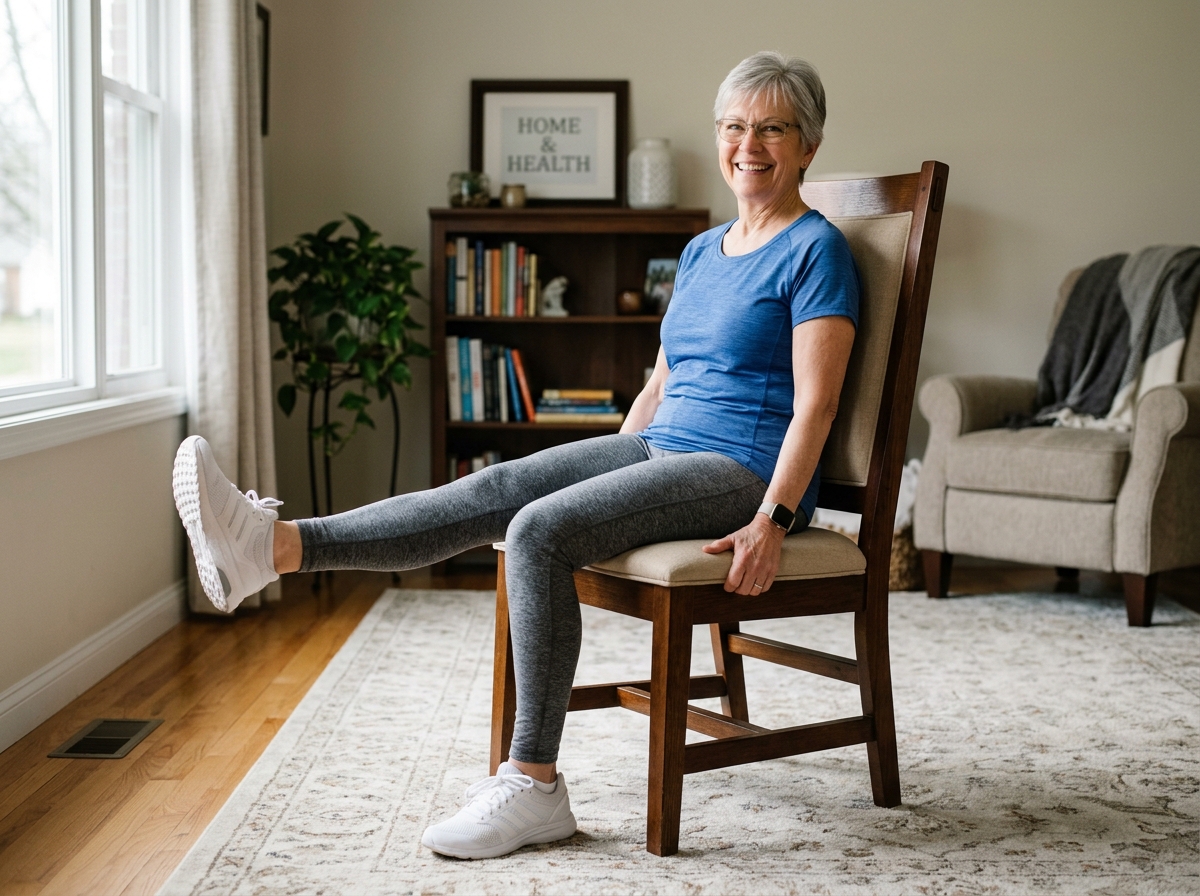
While sitting tall, slowly straighten one leg out in front of you. Squeeze your thigh muscle (the quadriceps) at the top, hold for a second, and lower it back down with control. This move is fantastic for knee stability. You can find more movements like this in our 10-minute daily workout routine for beginners.
3. Seated Rows
Extend your arms in front of you at chest height. Imagine you are grabbing a pair of handles and pull your elbows back past your ribs, squeezing your shoulder blades together. This helps correct “desk posture” and strengthens the upper back.
4. Heel Taps and Calf Raises
To keep your ankles strong and prevent falls, we include heel taps and calf raises. For calf raises, simply lift your heels as high as possible while keeping your toes on the floor. For heel taps, extend one leg and tap your heel on the floor, then bring it back. These are small movements that make a big difference in balance.
For a deeper dive into why these specific moves are so effective as we age, take a look at this 10-minute chair workout to build strength after 50.
Core-Focused 10 Minute Chair Workout for Beginners
The core is the “powerhouse” of the body. It supports our spine, helps us breathe, and is essential for balance. You don’t need to do crunches on the floor to get a strong stomach!
- Seated Marches: Sit tall and lift one knee toward your chest, then the other. Keep your hands on the sides of the chair for stability. This works your lower abdominals and hip flexors.
- Oblique Twists: Place your hands behind your head or across your chest. Slowly rotate your upper body to the right, then back to center, and then to the left. This targets the muscles on the sides of your waist.
- Seated Cat-Cow: This is a yoga-inspired move. Inhale as you arch your back and look up (Cow), then exhale as you round your spine and tuck your chin (Cat). It’s a great way to wake up the deep core muscles and improve spinal mobility.
If this is your very first time trying these, our your first home workout a beginners guide can help you build the confidence to keep going.
Mobility and Flexibility Movements
A 10 minute chair workout for beginners isn’t just about strength; it’s about being able to move freely.
- Seated Figure-Four: Cross your right ankle over your left knee. Gently lean forward until you feel a stretch in your hip. This is a lifesaver for people who sit a lot or deal with sciatica.
- Chest Openers: Reach your arms behind you and grab the back of the chair. Gently pull your shoulders back to open up the chest.
- Wrist and Ankle Circles: We often forget our extremities! Spend 30 seconds circling your wrists and ankles to keep the joints lubricated and reduce stiffness.
For more stretching ideas, explore the ultimate guide to beginner home workouts.
How to Progress and Modify Your Chair Exercises
The beauty of a 10 minute chair workout for beginners is that it can grow with you. Once the basic moves feel easy, we don’t want you to plateau. Progression is the key to continued muscle tone and bone density.
| Exercise | Beginner (Bodyweight) | Intermediate (Added Resistance) | Advanced (Challenge) |
|---|---|---|---|
| Chair Squats | Using arms for support | Hands across chest | Holding a water bottle or weight |
| Bicep Curls | Empty hands, focus on squeeze | Holding light dumbbells | Using a resistance band under feet |
| Leg Extensions | Slow, controlled reps | Adding ankle weights | Holding the extension for 5 seconds |
| Seated Marches | Standard pace | Lifting knees higher | Eyes closed to challenge balance |
Tips for Progression:
- Eccentric Control: This is a fancy way of saying “slow down on the way down.” For example, when doing a leg extension, take 3 seconds to lower your leg. This keeps the muscle under tension longer.
- Isometric Contractions: At the peak of a move (like the top of a bicep curl), squeeze the muscle as hard as you can for 2 seconds.
- Resistance Bands: These are affordable, lightweight, and can be looped around chair legs to add a whole new dimension of difficulty to your rows and leg presses.
To stay motivated as things get tougher, check out our beginner tips to stick to exercise routine.
Frequently Asked Questions About Seated Fitness
How often should I do a 10 minute chair workout for beginners?
Consistency is much more important than intensity. We recommend doing this workout 3 to 5 times a week. If you are just starting, 2 or 3 times is plenty. Your muscles need recovery days to repair and grow stronger. For more advice on building a routine that lasts, see our beginner tips to stick to exercise routine at home.
Who can benefit most from a 10-minute chair workout?
Almost everyone! While they are incredibly popular for seniors and those in injury recovery, they are also perfect for “desk warriors” who spend 8 hours a day in a chair. A quick 10-minute break can alleviate back pain and boost energy. Beginners who feel intimidated by the gym find this is a great “entry point” into fitness. It’s all part of our home workouts for beginners a comprehensive guide.
What equipment is needed for a 10 minute chair workout for beginners?
As we mentioned, a sturdy chair is the only “must-have.” However, you can use household items to add resistance. Full water bottles or soup cans make great “dumbbells.” A rolled-up towel can be used for stretching or as a “block” to squeeze between your knees to work your inner thighs. This makes it one of the most easy to follow beginner home workouts for weight loss because there are zero financial barriers to starting.
Conclusion
Starting a 10 minute chair workout for beginners is one of the best gifts you can give your future self. It’s about more than just muscle; it’s about the confidence to play with your grandchildren, the strength to carry your own groceries, and the freedom to move without pain.
At NextFin Capital, we believe that health is the ultimate investment. By spending just 10 minutes a day on these seated movements, you are building a foundation of physical wealth that will pay dividends for years to come.
Ready to take the next step? Start by creating a home fitness schedule that fits your life. If you enjoyed this routine, explore more workout routines on our blog to keep your journey exciting and fresh!
